


These are letters I’ve been writing to my son Will since before he was born.
Yesterday was June 3, 2026. Your grandmother, my mother, would have been 96. I waited a day, in part to write about this, in deference to her. You see she didn’t celebrate birthdays or really any milestones as far as I could tell. She was a pious woman who, much like myself, took the portions of religion that aligned with her own views and left behind the brick, mortar and blood of the congregation.
It’s very difficult for me to tell you about her, to try and faithfully describe her to you, but I think also there is great merit to be found in that doing, somehow. There must be, I think. It bears all the signs of a great lesson. Discomfort, distortion, disassociation — lots of disses. I’ll do my utmost not to disrespect her and therefore myself and our family in the process.
Lottie Louise Oswald was born June third in the year nineteen thirty, in Allendale, South Carolina, the sixth of ten children. She grew up there on the family’s small farm. She told me often of the many difficulties then. Stories common to most everyone during the Great Depression, but maybe particularly daunting to such a large family in such desperate times. I don’t pretend to understand what her circumstances were — of course I could not — but I do know she spoke reverently about her father and mother both, and the sacrifices they made to sustain such a large family. They grew their own meals as did their neighbors. I think they were often struggling to make ends meet but maybe more fortunate than many others. Her dad was well respected, as I understand it, and a leader at their local church.
She loved her brothers and sisters, mostly I think, although I know she also carried deep wounds as well. It is probably impossible for either of us to even begin to imagine the circumstances of such a life and the complex dynamics of their reality. I know she adored her brother Nathan, who was tragically killed at age eight by a watermelon truck driven by her father. I cannot imagine the pall that must have cast.
She told me about some darker things still. Terrible things that I’ve decided I’m not going to relay to you, and that creates a problem for me. I will always tell you the truth as I understand it, to the very best of my ability. Always. That’s our pact, our agreement. But I’ve come to understand that truth does change and has timbre. Perspective, circumstance, timing and wisdom all shade and shape the different realities as we perceive them. Her truth is hers alone, and mine is mine. That’s not dishonesty or even distortion. It’s physics. I’d do you, her and myself a disservice by retelling poorly related and misspoken fractured memories, spilled in the light of who knows what revelation. I will share my truth with you, but remember I’m not myself above remembering things wrongly — and in the end, the now, only this and each moment of clarity that you find, matters. Specifically, that is to say: make the lesson matter, or accept that you’ll repeat it.
Soon after high school, mom married her first husband, Robert Ray Kennedy. I met him several times before he passed in 1974. He was, as I remember, a very charismatic and interesting man. He had something rare and impossible to describe — a je ne sais quoi, if you will — although I can almost guarantee he’d not likely appreciate that description. He was also, by every account I’ve heard, a badly affected alcoholic. Mom described it in the most dire terms. I’m not trying to tell his or even her whole story as I know it, but this I think bears directly into my understanding of who she was.
Mom married my dad in 1965, I believe. She told me it was a marriage of necessity and that if I were to look at exact dates the math would bear that out. I never did.
I was born in Tucson. Dad was the cotton gin manager in Marana, where they had a house on the gin yard adjacent to the I-10, and mom had been his secretary. Around my third year, dad was transferred to Phoenix to manage the Avondale and also later the Rainbow Valley gins.
This is where I can begin to add a little of my own perspective and — astonishingly — this is also where you first came into my imagination.
I don’t have any experience or memories of what I’d call family life in childhood. My earliest memories are of late night screaming and fighting. They must have really hated each other. I did see them push every single button. Dad was an alcoholic. Mom — well, mom was harder to clock. She’d married two alcoholic men and had four children and at around the age of 40, she’d found religion again. Actually, perhaps it found her.
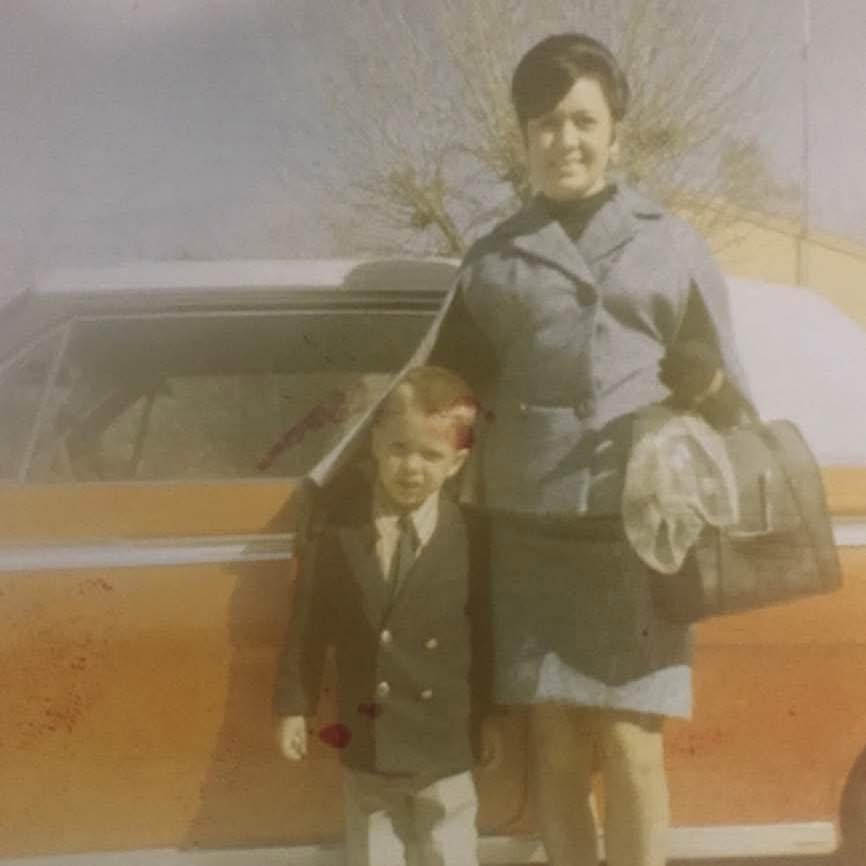
It came to the door and knocked, and soon after, her and I were attending meetings three times a week and going door to door ourselves on weekends to share our good news. The divorce coincided with her new worldview, thankfully, and dad moved west some twenty miles to Avondale, closer to his offices. I was 5 then.
I’m not going to sugarcoat anything. If I was resilient in this phase of life, I don’t remember it that way. I do remember this, and I alluded to it earlier: I disapproved so much of my situation that I, at a very early age, began to resolutely plan to be a parent better than my own. It was a driving force in my thinking, and every time my mother disparaged my father or told me through tears that he wanted to abort me, I thought of how when I would someday have the opportunity, I would just be better. I’d find time. I’d be present. I’d play. I’d pray too, but not in some theatrical ceremony, cowering at my bedside — but in reverence and joy. In conscious awareness. In gratitude. Grateful for the moment at hand, the now, and not distracted or disturbed by what’s been or what reward I’ll have once this body is dust.
Your grandmother did pass on some very admirable qualities to us both, I think. A few years before she died, I was contacted by a New York Times reporter who was writing a feature on the great American artist Jasper Johns. Johns and mom were childhood friends, and evidently mom had made quite an impression on him. As the story was related to me, and later in the Times, it said:
“One day when he was in the second grade, a classmate named Lottie Lou Oswald misbehaved and was summoned to the front of the room. As the teacher reached for a wooden ruler and prepared to paddle her, Lottie Lou grabbed the ruler from the teacher’s hand and broke it in half. Her classmates were stunned.
“It was absolutely wonderful,” Mr. Johns told me, appearing to relish the memory of the girl’s defiance. A ruler, an instrument of the measured life, had become an accessory to rebellion.”
I see that quality in you. That sense of fearless justice. It can be an incredible asset — a truly remarkable trait found in the most heroic of mankind — but take great care too, son, because it can also lead to becoming too sure of your own righteousness and ultimately a failure of character. Even as I write you this very moment I must check myself constantly and purge any inclination towards sanctimony.
Mom often lost sight of perspective. In an ironic twist, the girl who broke the instruments of discipline later found them useful in pursuit of enforcing her own will. There is no doubt that like her, I was a strong willed child, but there can never be a reason to hit your child. Spare the rod, spoil the child was a common refrain in our house, and she’d sometimes cry and hug and kiss afterwards — but she’d also flail me ragged. Even my school became concerned when the welts and bruises started coming more frequently. Eventually, when I’d grown strong enough, I simply put my hand out and took the belt from her. It was a startling moment. Her face immediately changed, and I imagine at that moment she finally realized her mistake and remembered her own childhood, her own fragile vulnerability. It went from self righteous rage — to a childlike shade of fear. She never tried to hit me again, and that day I stopped hiding my leather belts.
I won’t make excuses for her, or try and explain away the wrongness of her actions. I’ll neither accuse her. We all do the things we do in the moment, right or wrong. It’s the platform. The school of life.
I’m going to make lots of mistakes fathering you. I wrote that sentence and then I broke. All the remembering, the writing I just did, the painful memories — that didn’t bother me at all. But thinking of the mistakes I’ve yet to make somehow makes me weep like there’s no tomorrow. And laugh.
God is great and not a little brilliant.
Love, Dad
I can relate! Glad you chose to do better rather than perpetuate the tradition.
Very touching 😭❤️